If you ask an insulation engineer which calcium silicate grade they reach for most often, the answer is almost always the same: N-14. The 850kg/m³ N-14 grade has earned its reputation as the workhorse of structural insulation — reliable, strong, well-documented, and trusted across industries from petrochemical refining to power generation.
This guide covers everything you need to know about the N-14 grade: what makes it the industry standard, where it performs best, and how it compares to other options in the HR RHINO high density product line.
What Is N-14 Grade Calcium Silicate Board?
The N-14 designation refers to a specific performance standard for calcium silicate insulation that combines moderate-to-high density with excellent all-around properties. At 850 kg/m³, the N-14 grade occupies the middle ground of the high density range — denser and stronger than standard insulation boards, but not as specialized as grades designed for molten metal contact or extreme thermal shock.
This balance is exactly what makes it so popular. The N-14 grade does everything well: thermal insulation, mechanical load-bearing, dimensional stability, moisture resistance, and CUI protection. It may not be the absolute best at any single property, but it delivers consistently good performance across all of them.
Technical Specifications
Bulk Density: 850 kg/m³
Compressive Strength: ≥ 10 MPa
Flexural Strength: ≥ 5 MPa
Max Service Temperature: 1100°C
Long-term Service Temperature: 1000°C
Thermal Conductivity (200°C): ≤ 0.10 W/m·K
Linear Shrinkage (1000°C, 24h): ≤ 2.0%
Chloride Content: Low (CUI Compliant)
Asbestos Content: 0% (Asbestos-free)
Standard: ASTM C533 Compliant
Why N-14 Became the Industry Standard
1. ASTM C533 Compliance
The N-14 grade meets or exceeds ASTM C533 requirements for calcium silicate insulation — the benchmark standard used by specification engineers worldwide. When a project specification calls for "calcium silicate per ASTM C533," the N-14 grade is typically the go-to product. This standardization simplifies procurement, reduces qualification testing, and gives project engineers confidence in the material's performance.
2. CUI Protection — The Silent Killer in Insulation
Corrosion Under Insulation (CUI) is one of the most expensive maintenance problems in the petrochemical and refining industries. It occurs when moisture penetrates insulation and causes the underlying steel to corrode — often invisibly until a pipe or vessel fails catastrophically.
The N-14 grade fights CUI on two fronts. First, its low chloride content means the board itself does not contribute corrosive agents to the system. Second, its moderate density allows controlled moisture movement — the board can dry out after wetting events rather than trapping moisture against the metal surface indefinitely.
This makes N-14 the preferred choice for outdoor pipe and vessel insulation in refineries and chemical plants where CUI risk is a primary design consideration.
3. The Perfect Strength-to-Weight Ratio
At 850 kg/m³, the N-14 grade is strong enough to be self-supporting on large-diameter pipes and vessel walls without sagging, crushing, or deforming under its own weight. Yet it is not so dense that it becomes difficult to handle, cut, and install in the field.
Compressive strength of ≥10 MPa means the board can support cladding systems, foot traffic during maintenance, and mechanical loads from supports and hangers without permanent deformation.
4. Excellent Thermal Performance
Thermal conductivity of ≤0.10 W/m·K at 200°C places the N-14 grade among the most efficient high density insulation materials available. Lower density boards may offer slightly better insulation per unit thickness, but they cannot match the N-14's combination of thermal performance and mechanical strength.
5. Proven Track Record
The N-14 grade has been used in petrochemical, power, and industrial applications for decades. Engineers specify it because they have data — years of field performance data — proving that it works. In an industry where failure can mean explosions, fires, or environmental disasters, that track record matters enormously.
Primary Applications
Petrochemical Refineries and Chemical Plants
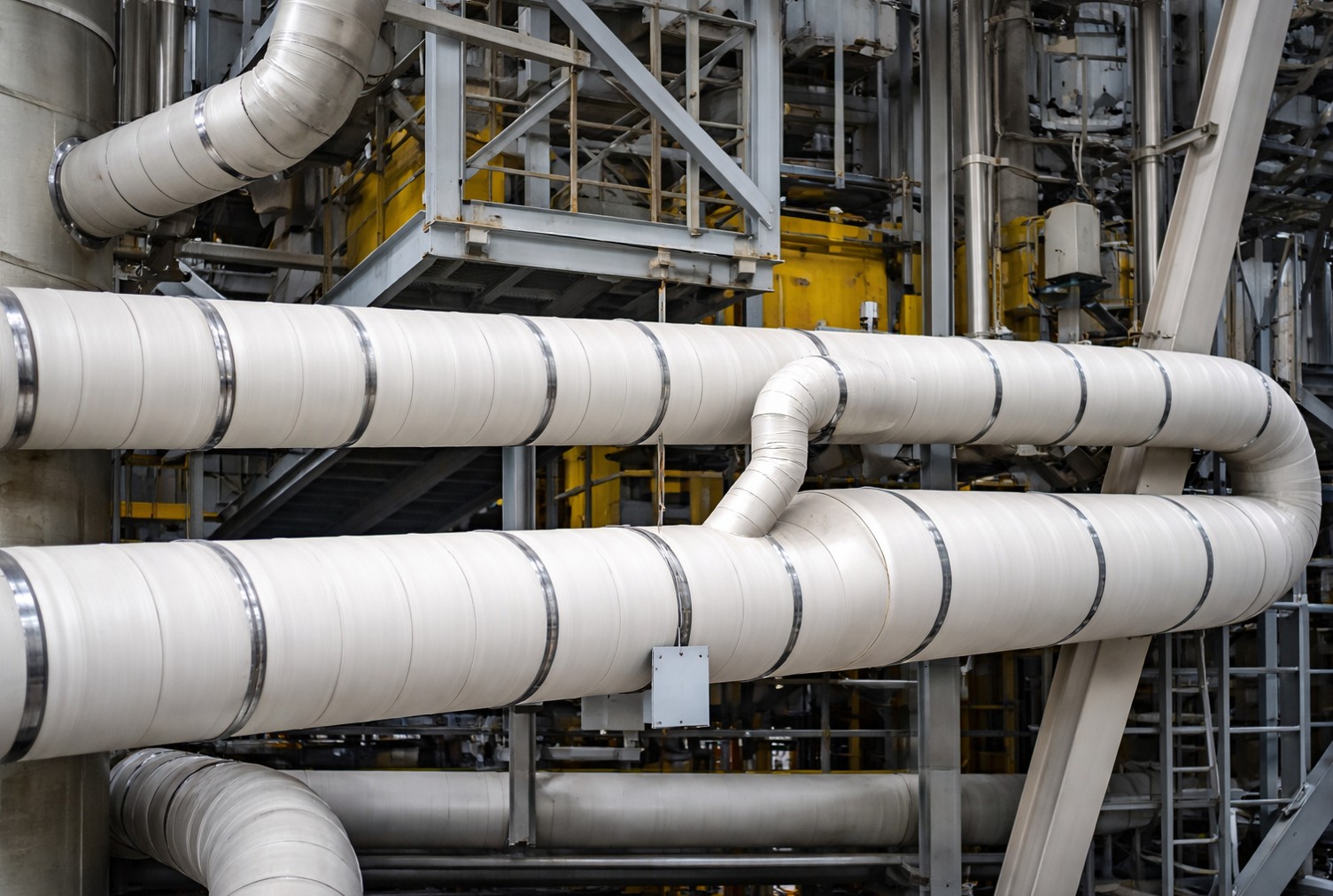
This is the N-14 grade's home territory. It is specified for pipe insulation on hot process lines (up to 600°C typical), vessel and column insulation, heat exchanger shells, tank insulation, and equipment operating in the CUI temperature range (50–175°C) where corrosion risk is highest.
In refinery applications, the N-14 grade is often specified as part of a complete CUI prevention strategy that includes the insulation itself, weather barriers, protective coatings, and inspection programs.
Power Generation
Used extensively around boiler drums, steam headers, turbine casings, and high-temperature ductwork. The N-14 grade's ability to maintain dimensional stability through startup and shutdown cycles makes it reliable in both baseload and cycling power plants.
Industrial Process Equipment
Anywhere that hot equipment needs insulation with structural integrity — furnaces, ovens, kilns, dryers, and heated vessels across chemical processing, food manufacturing, pharmaceutical production, and other industries.
LNG and Cryogenic Applications
While primarily known as a high-temperature insulation, the N-14 grade also performs well in certain elevated-temperature zones of LNG facilities where both thermal insulation and structural support are needed.
Offshore and Marine
The N-14 grade's combination of strength, low chloride content, and moisture tolerance makes it suitable for offshore platform insulation where salt spray, humidity, and mechanical vibration are constant challenges.
N-14 vs Other HR RHINO High Density Grades
Choosing the right grade starts with understanding your primary challenge:
N-17 Carbon Fiber (800 kg/m³) — Choose when you need fiber reinforcement for casting or forming applications. The carbon fiber adds toughness but is less relevant for standard pipe and vessel insulation.
N-14 Structural (850 kg/m³) — Choose for general-purpose structural insulation, especially in petrochemical and power applications. The default choice when no specialized requirement overrides it.
Thermal Shock (980 kg/m³) — Choose when rapid, repeated temperature cycling is the primary concern. The 980 grade trades some versatility for superior thermal fatigue resistance.
Molten Aluminum (1020 kg/m³) — Choose only when the board will contact molten aluminum directly. The non-wetting surface is critical for this application but adds cost without benefit elsewhere.
High Strength (1200 kg/m³) — Choose when maximum mechanical strength is the overriding requirement and weight is not a concern.
The decision flowchart for most projects is simple: start with N-14 unless a specific application requirement pushes you toward a specialized grade.
Specification and Procurement Tips
For engineers and procurement teams specifying N-14 calcium silicate board, here are practical recommendations:
Specify ASTM C533 compliance in your material requirements — this ensures you receive a product that meets recognized performance standards regardless of supplier.
Request a Certificate of Conformance (CoC) with each shipment confirming density, strength, and thermal conductivity test results for that specific production batch.
Specify low-chloride grade explicitly if CUI prevention is a design priority. Not all calcium silicate boards have equally low chloride content.
Consider thickness optimization — the N-14 grade's excellent thermal conductivity often allows thinner insulation than lower-density alternatives, potentially reducing material cost and installed weight.
Request factory cutting for complex shapes — HR RHINO offers CNC cutting services that can reduce field labor and material waste significantly.
Installation Best Practices
The N-14 grade cuts cleanly with standard carbide-tipped tools. For optimal performance:
Use two-layer staggered joint installation on pipes over 300mm diameter to eliminate thermal bridges at joints.
Apply appropriate vapor barriers on cold-side applications to prevent moisture ingress.
Use stainless steel banding or jacketing — avoid carbon steel in CUI-prone environments.
Maintain specified gaps at expansion joints to allow for thermal movement without board damage.
Store boards in dry, covered conditions before installation. While the N-14 grade tolerates moisture better than many insulation materials, starting dry ensures optimal initial performance.
Ordering from HR RHINO
HR RHINO manufactures N-14 grade 850kg/m³ calcium silicate boards at our Qingdao, China facility with an annual production capacity exceeding 20,000 m³. We supply:
Standard board sizes with thickness from 15mm to 100mm