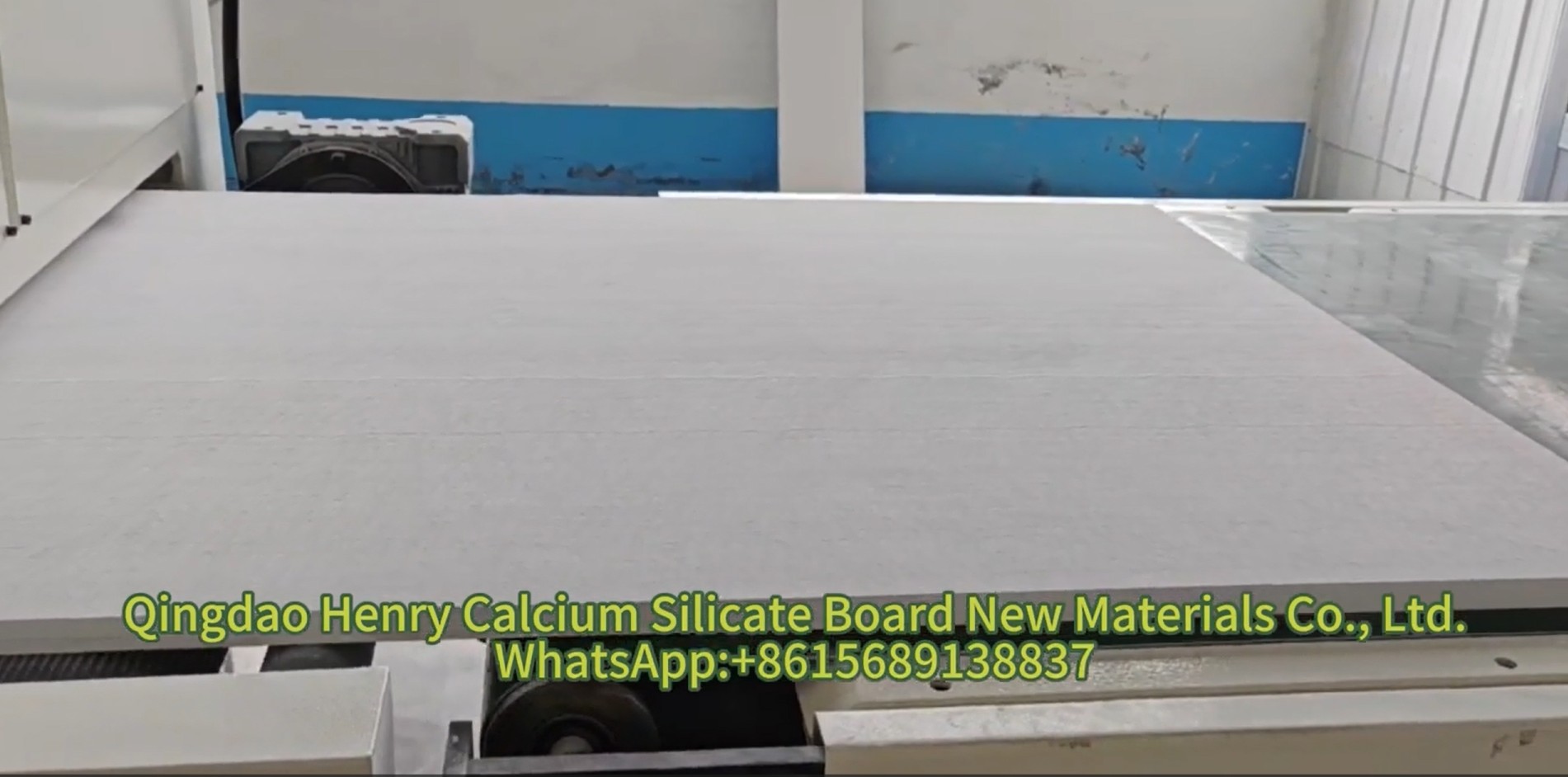
Have you ever wondered how a calcium silicate insulation board is manufactured? What transforms raw minerals into a rigid, heat-resistant board capable of withstanding 1100°C?
In this article, we take you inside the HR RHINO factory in Qingdao, China and walk you through the complete production process — from raw material preparation to final quality inspection. Watch our factory production video above to see each step in action.
Our Manufacturing Facility
HR RHINO operates a modern calcium silicate board manufacturing facility in Qingdao, Shandong Province, China. With an annual production capacity exceeding 20,000 cubic meters, the factory produces the full range of calcium silicate boards from lightweight 220 kg/m³ insulation grades to ultra-high density 1200 kg/m³ structural grades.
The facility runs continuously to meet demand from customers in over 30 countries across North America, Europe, Middle East, Asia, Africa, and South America.
Step 1: Raw Material Preparation
The production process begins with carefully measured raw materials. The primary ingredients for xonotlite-based calcium silicate board are silica (SiO₂), lime (CaO), and reinforcing fibers. Each raw material is sourced from qualified suppliers and tested for chemical purity before entering the production line.
Precise proportioning is critical. The ratio of silica to lime determines the crystal structure of the final product — and ultimately its thermal and mechanical properties. Our automated batching system ensures consistency from batch to batch, which is why HR RHINO boards deliver reliable performance across every shipment.
Step 2: Mixing and Slurry Formation
The dry raw materials are combined with water in high-speed mixers to form a uniform slurry. This slurry must achieve a specific consistency and particle distribution to ensure even formation in the next stage.
Reinforcing fibers are added during mixing. For standard grades (220–500 kg/m³), cellulose and mineral fibers provide structural reinforcement. For specialty grades like the N-17 (800 kg/m³), carbon fiber and glass fiber are incorporated to achieve the enhanced fracture toughness that makes this grade unique.
Step 3: Board Formation
The prepared slurry is poured into precision molds and formed under controlled pressure. This step determines the board's density — by controlling the amount of slurry and the applied pressure, we produce boards ranging from 220 to 1200 kg/m³ with precise density control.
The formation process is where the quality of the finished product is largely determined. Uneven filling, incorrect pressure, or contaminated molds produce boards with inconsistent density and weak spots. Our automated formation lines eliminate these variables, producing boards with uniform density throughout.
Step 4: Autoclave Curing — The Heart of the Process
This is the most critical step in calcium silicate board manufacturing. The formed boards are loaded into large autoclaves — pressure vessels that use saturated steam at elevated temperature and pressure to drive the chemical reaction that creates xonotlite crystals.
Inside the autoclave, the following reaction occurs: silica and lime react with water under hydrothermal conditions to form xonotlite (6CaO·6SiO₂·H₂O). This crystal structure is what gives calcium silicate board its unique combination of thermal stability, low conductivity, and mechanical strength.
The autoclave cycle runs for 10–20 hours depending on the product grade, at temperatures of 180–220°C and pressures of 1.0–2.0 MPa. The process parameters are precisely controlled and monitored throughout the cycle.
Step 5: Drying
After autoclave curing, the boards contain residual moisture that must be removed before the product can be used. The boards are transferred to drying chambers where controlled airflow and temperature gradually reduce moisture content to the specified level.
Drying must be done carefully — too fast and the boards crack from internal steam pressure; too slow and production efficiency suffers. Our drying process is optimized through years of experience to achieve the right balance.
Step 6: Precision Cutting and Finishing
The dried boards are cut to final dimensions using automated cutting equipment. Standard sizes are 1000mm × 500mm, but our CNC cutting capabilities allow any custom size and shape to be produced.
For high density grades (800–1200 kg/m³), additional finishing operations may include surface grinding for flatness, edge profiling, and precision machining of custom shapes for specific applications like aluminum casting molds and launder sections.
Step 7: Quality Control and Testing
Every production batch undergoes comprehensive quality testing before being approved for shipment. Our quality control laboratory tests for bulk density using calibrated measurement of weight and dimensions, compressive strength and flexural strength using universal testing machines, thermal conductivity using guarded hot plate method, dimensional tolerance verification, visual inspection for surface defects, and chemical composition analysis for raw materials and finished products.
Test results are recorded and a Certificate of Conformance is available for every shipment. We maintain full traceability from raw materials through to the finished product delivered to your project site.
Step 8: Packaging and Shipping
Approved boards are packaged in our export packaging system designed specifically for safe ocean freight transport. The packaging protects against moisture, mechanical damage, and stacking loads during container shipping.
Standard packaging includes shrink-wrap protection for each board, cardboard edge protectors, palletization for forklift handling, and weather-resistant outer wrapping. Custom packaging is available for special requirements.
Why Factory-Direct Matters
When you buy from HR RHINO, you are buying directly from the manufacturer — not from a trader, distributor, or middleman. This means you get full traceability from raw material to finished product, direct access to our technical team for application support, the ability to request custom specifications and sizes, competitive pricing without markup from intermediaries, and consistent quality backed by our manufacturing expertise.
Visit Our Factory
We welcome customers and partners to visit our factory in Qingdao. A factory tour gives you the opportunity to see the production process firsthand, meet our technical team, inspect quality control procedures, and discuss your specific requirements directly with our engineers.
Contact us to arrange a factory visit or to request more information about our manufacturing capabilities.
Ready to Order?
Whether you need standard calcium silicate boards for industrial furnace insulation or custom-engineered high density components for specialized applications, HR RHINO has the manufacturing capability, product range, and technical expertise to serve your project.
Contact our team today for a quotation, free samples, or technical consultation. We respond to all inquiries within 24 hours.