Standard calcium silicate boards are strong in compression but brittle under impact. Drop one on a concrete floor and it shatters. Hit one with a casting ladle and it cracks. In aluminum casting operations where boards are handled daily, subjected to mechanical impact, and exposed to thermal shock from molten metal contact — this brittleness is more than an inconvenience. It is a production problem.
The N-17 grade solves it by embedding carbon fiber reinforcement directly into the calcium silicate matrix. The result is an 800kg/m³ board that combines the thermal and chemical properties of calcium silicate with the fracture toughness and impact resistance of a fiber-reinforced composite.
This guide explains how carbon fiber reinforcement changes the performance characteristics of calcium silicate, where the N-17 grade outperforms conventional boards, and how to decide whether it is the right choice for your application.
What Carbon Fiber Does Inside Calcium Silicate
Calcium silicate is a ceramic material. Like all ceramics, it is strong under compressive loads but weak under tension, bending, and impact. Cracks propagate easily through the rigid crystal structure — once a crack starts, nothing stops it from growing until the board breaks.
Carbon fibers change this behavior fundamentally. Distributed throughout the xonotlite matrix, the fibers act as crack arrestors. When a crack encounters a carbon fiber, the fiber bridges the crack and redistributes the stress. Instead of a single catastrophic fracture, the material develops many micro-cracks that the fibers hold together — maintaining structural integrity even after damage that would destroy an unreinforced board.
This mechanism is called crack bridging, and it transforms calcium silicate from a brittle ceramic into a damage-tolerant composite. The board still has the thermal resistance, chemical inertness, and non-wetting properties of calcium silicate — but it can now survive the rough handling, mechanical impacts, and thermal shocks that are unavoidable in real-world foundry environments.
Technical Specifications
Bulk Density: 800 kg/m³
Compressive Strength: ≥ 8 MPa
Flexural Strength: ≥ 6 MPa
Max Service Temperature: 1100°C
Long-term Service Temperature: 1000°C
Thermal Conductivity (200°C): ≤ 0.09 W/m·K
Linear Shrinkage (1000°C, 24h): ≤ 2.0%
Fiber Reinforcement: Carbon fiber + glass fiber
Non-Wetting with Aluminum: Yes
CNC Machinable: Yes
Asbestos Content: 0% (Asbestos-free)
Five Advantages That Set N-17 Apart
1. Fracture Toughness — It Bends Before It Breaks
This is the defining advantage. Standard calcium silicate boards fail suddenly and completely under impact or bending loads. The N-17 grade absorbs energy and deforms before breaking — giving operators warning before failure and surviving impacts that would shatter unreinforced boards.
In practical terms, this means fewer boards broken during handling, installation, and operation. For a busy casting operation that goes through dozens of boards per month, the reduction in breakage alone can justify the price premium.
2. Superior Thermal Shock Resistance
The carbon fibers improve thermal shock resistance beyond what density alone can achieve. When one side of the board is suddenly heated by molten metal contact while the other side remains cool, the resulting thermal stress creates tensile forces that crack ordinary boards. The fiber reinforcement holds the board together through these events.
This makes the N-17 grade particularly valuable in applications where boards are repeatedly exposed to molten metal splashes — each splash creates a localized thermal shock that conventional boards must resist through material strength alone.
3. Non-Wetting Surface for Molten Aluminum
Like the 1020kg/m³ grade, the N-17 board provides a non-wetting surface that resists molten aluminum penetration. The 800 kg/m³ density is slightly more porous than the 1020 grade, but the combination of optimized surface chemistry and fiber reinforcement still prevents metal adhesion in most casting contact applications.
For applications requiring sustained immersion in molten aluminum, the 1020kg/m³ grade remains the better choice. But for splash contact, intermittent contact, and casting mold applications, the N-17 offers sufficient non-wetting performance with the added benefit of superior toughness.
4. Lowest Thermal Conductivity in the High Density Range
At ≤0.09 W/m·K (200°C), the N-17 grade offers the best thermal insulation performance of any HR RHINO high density board. This is a direct result of its relatively lower density — 800 kg/m³ compared to 850–1200 kg/m³ for other high density grades. More porosity means more trapped air, which means better insulation.
For applications where both insulation efficiency and mechanical toughness matter, the N-17 delivers a combination that no other single grade can match.
5. Excellent CNC Machinability
The carbon fiber reinforcement actually improves machinability compared to unreinforced boards. The fibers prevent edge chipping during cutting and drilling — a common problem with brittle ceramic boards that creates rough edges and dimensional inaccuracy.
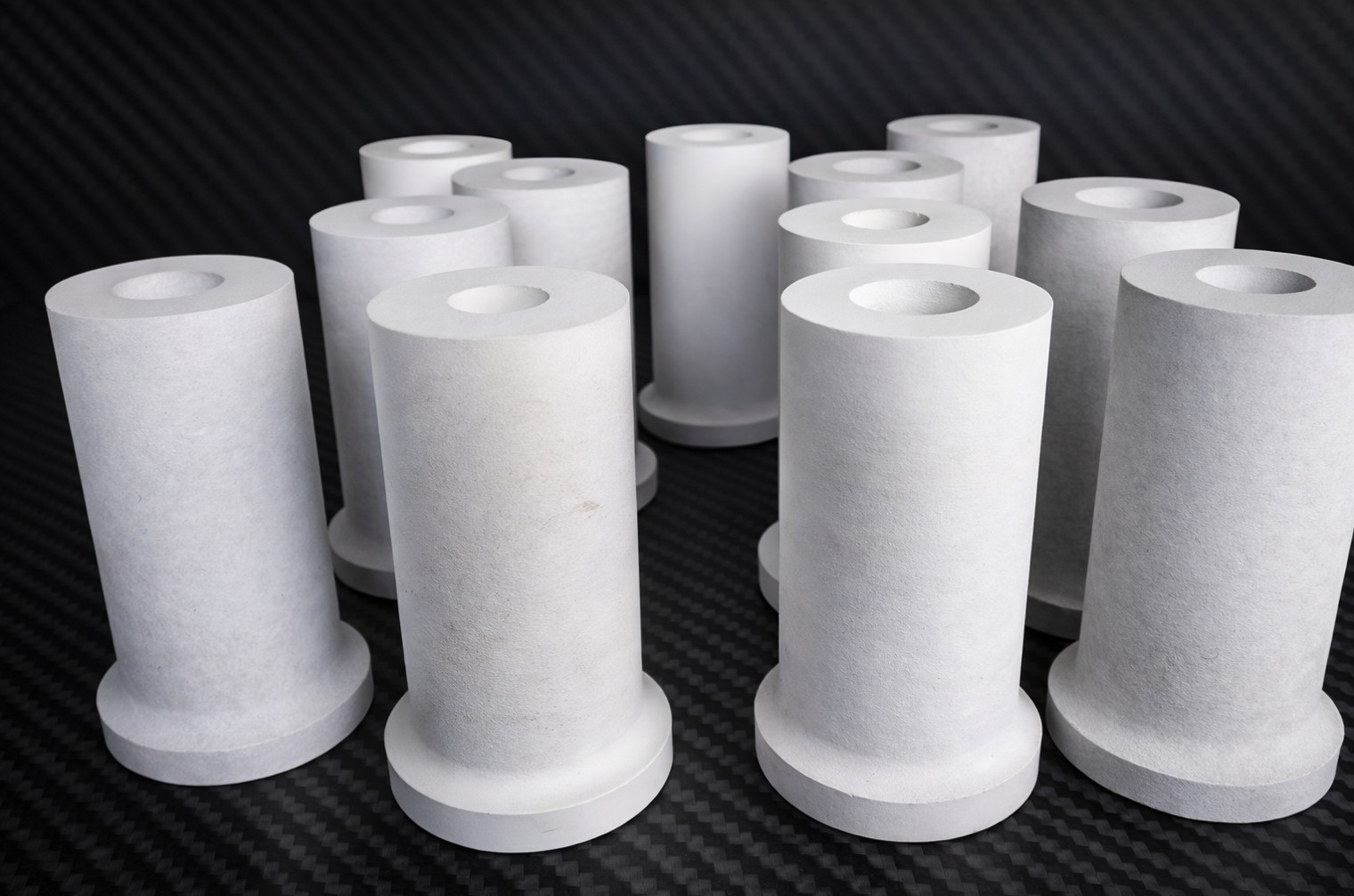
CNC-machined N-17 components come out with clean, sharp edges and precise dimensions. This matters for precision casting molds, custom launder sections, and any application where dimensional accuracy directly affects product quality.
Where N-17 Excels
Aluminum Casting Molds and Headers
The N-17 grade is used to fabricate the insulating components of vertical and horizontal casting molds. Its combination of non-wetting surface, thermal insulation, machinability, and toughness makes it ideal for mold headers, transition plates, and distribution trays where the board directly contacts or closely surrounds the molten metal stream.
The fracture toughness is critical here — casting mold components experience repeated thermal shock with every casting cycle, plus mechanical loads from clamping, alignment, and metal hydrostatic pressure.
Reusable Casting Tooling
Because the N-17 grade survives impacts and thermal cycles that destroy standard boards, it can serve as reusable tooling rather than disposable insulation. Custom-machined N-17 components for casting systems often achieve 50–200+ casting cycles before replacement — significantly more than unreinforced alternatives.
This reusability transforms the economics of the product. While the per-board cost is higher than standard grades, the cost per casting cycle is often lower because each board lasts so much longer.
Launder and Trough Linings
In aluminum transfer systems, the N-17 grade provides launder linings that resist both the thermal shock of metal filling and the mechanical shock of cleaning and maintenance operations. Foundry workers can scrape, tap, and clean N-17-lined launders without the fear of cracking the insulation that accompanies work on standard boards.
Crucible and Furnace Furniture
Small furnace components — crucible supports, thermocouple protection tubes, charge guides, and similar "furniture" items — benefit enormously from the N-17's toughness. These components are frequently handled, moved, and knocked during furnace operations. Fiber reinforcement dramatically extends their service life.
Precision Industrial Components
Beyond the aluminum industry, the N-17 grade is used wherever precision-machined insulation components need to survive mechanical handling and thermal cycling. Applications include glass manufacturing tooling, heat treatment fixtures, laboratory furnace components, and kiln furniture.
N-17 vs 1020kg/m³ — When to Choose Which
This is the most common comparison question for aluminum processing applications:
Choose N-17 (800 kg/m³) when:
— The board will be handled frequently and rough handling is expected
— Impact resistance and fracture toughness are critical
— The application involves intermittent or splash contact with molten aluminum
— You need the best thermal insulation per unit thickness
— The board will be CNC-machined into precision components with sharp edges
— Boards must survi